
How Leadership Decision Drag Is Quietly Costing Companies Millions
Most CEOs believe their greatest challenge is market competition, economic uncertainty, or operational complexity.
In reality, many organizations are being slowed down by something much closer to home:
The CEO themselves.
Not because they lack capability.
Not because they are making poor decisions.
But because the organization has unintentionally trained itself to believe that every important decision must flow through one person.
This creates what we call CEO Decision Drag – a silent organizational tax that grows larger as a company scales.
A Real-World Executive Intervention
During an intervention with a multinational energy company operating across four continents and generating billions in annual revenue, I took an unconventional approach.
Rather than facilitating workshops or reviewing strategic plans, I spent 72 hours shadowing the CEO.
Every interaction was documented.
Every request for approval was tracked.
Every decision routed to the CEO was counted.
Over those three days, 47 separate issues landed on the CEO’s desk requiring an answer, approval, or direction.
What we discovered was startling.
Only 11 of those decisions genuinely required the CEO’s authority, expertise, or executive judgment.
The remaining 36 decisions could have been handled effectively by capable leaders throughout the organization.
Yet they weren’t.
The culture had conditioned people to seek permission rather than exercise judgment.
The greatest leadership bottleneck isn't a lack of talent. It's a culture that teaches talented people not to act.
The True Cost of CEO Decision Drag
Most leaders underestimate the financial impact of centralized decision-making.
When decisions pile up at the top:
- Innovation slows
- Customer response times increase
- Projects wait in queues
- Leadership teams become dependent
- Future executives fail to develop decision-making confidence
- Strategic priorities get crowded out by operational noise
The CEO becomes the busiest person in the company while simultaneously becoming the largest source of delay.
This is not a leadership problem.
It is an organizational architecture problem.
The systems, expectations, and cultural norms that worked when the company was smaller often become liabilities as the organization grows.
What once created control now creates friction.
Why High-Growth Organizations Struggle
Many founders and CEOs unknowingly create dependency cultures.
Initially, this makes sense.
In the early stages, leaders possess the majority of institutional knowledge and make most critical decisions.
However, as organizations expand, complexity increases faster than any single leader’s capacity.
Yet many companies never redesign their decision-making systems.
The result is predictable:
Growth accelerates.
Decision-making does not.
The organization becomes constrained by executive bandwidth.
The speed of an organization is determined less by strategy and more by how many decisions can be made without the CEO
Leadership Scale Requires Decision Scale
World-class organizations understand a simple principle:
The goal is not to make every decision. The goal is to build leaders who can.
When executives empower capable people with clear accountability and decision rights:
- Execution accelerates
- Innovation increases
- Leadership capacity expands
- Organizational resilience improves
- CEOs regain time for strategic thinking
The highest-value contribution of a CEO is not approving routine decisions.
It is shaping vision, culture, strategy, partnerships, and long-term growth.
Every unnecessary approval request steals time from those responsibilities.
Conduct Your Own CEO Drag Audit
For one week, track:
- Every approval request
- Every decision escalation
- Every “quick question”
- Every phone call seeking permission
Then ask yourself:
How many of these genuinely required my expertise?
Many leaders discover that they are spending significant portions of their week solving problems that should be solved elsewhere in the organization.
This realization often becomes the turning point in creating a scalable leadership culture.
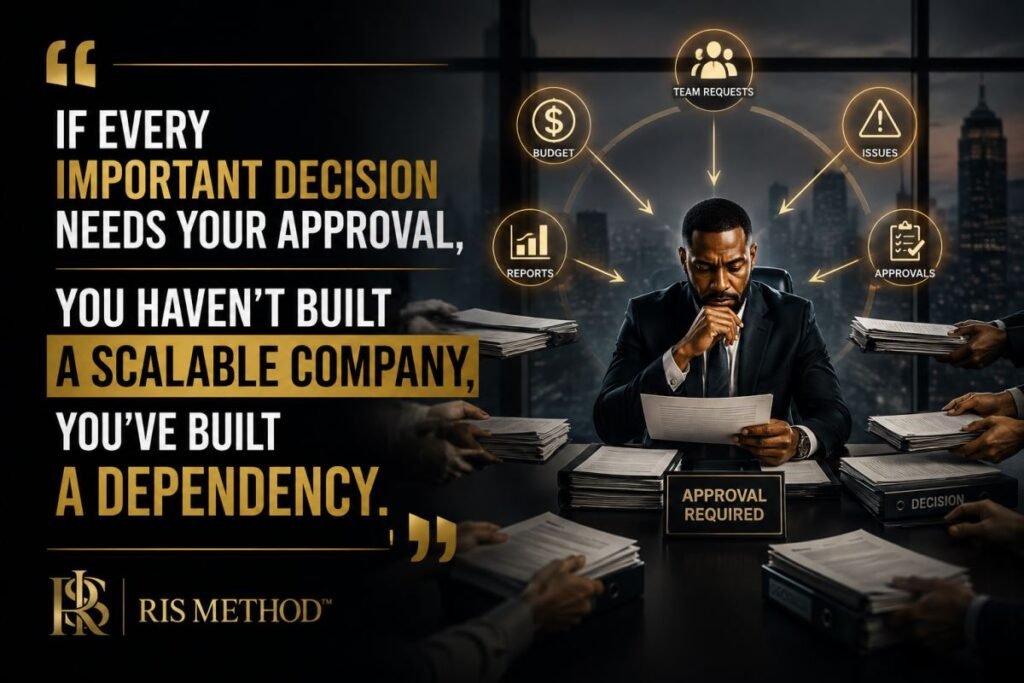
If every important decision needs your approval, you haven't built a scalable company—you've built a dependency.
Measuring Leadership Friction
The encouraging news is that leadership drag is measurable.
And what can be measured can be improved.
Organizations that systematically identify decision bottlenecks often unlock dramatic gains in execution speed, leadership effectiveness, accountability, and profitability.
The question is not whether leadership friction exists.
The question is whether you know where it exists and what it is costing your organization.
Executive Briefing: Discover What's Slowing Your Organization
If you’re a CEO, founder, board member, or senior executive responsible for organizational performance, we invite you to request a confidential executive briefing.
During this briefing, you’ll discover:
- Hidden decision bottlenecks slowing execution
- Sources of leadership friction reducing performance
- Why capable teams stop exercising judgment
- The measurable cost of CEO Decision Drag
- Practical strategies to increase organizational speed and accountability
Request your private executive briefing today:
https://rismethod.com/leadership-friction-suite/
The fastest-growing organizations are not led by executives who make more decisions.
They are led by executives who create systems that enable great decisions to happen without them.