
The Secret to Building an Engaged Leadership Team: Why Great CEOs Build Relationships, Not Just Results
Most CEOs believe employee engagement is created through compensation, incentives, culture programs, team-building exercises, or better communication.
Those things can help. But they are not the foundation.
The strongest organizations are built around something much deeper: people who genuinely care about what they do, the people they serve, and the people they work alongside.
I recently watched a CEO demonstrate this in a way that perfectly illustrates what real leadership looks like.
He was on his way to an important meeting with a potential supplier—a company he had been pursuing for some time. The supplier was highly professional, consistently delivered, and represented a potentially valuable relationship.
The meeting was important.
The CEO was already running late.
Then, as we stepped out of the elevator, he encountered an older couple he knew.
What happened next was fascinating.
They greeted each other like old friends. They hugged. They started talking about their families, their children, university, life and everything in between.
Minutes passed.
Then more minutes.
We were supposed to be at the meeting.
Yet the CEO wasn’t anxious.
He wasn’t pretending to listen while checking his watch.
He was completely present.
And eventually, something remarkable happened.
When we finally reached the supplier, the supplier discovered that the person the CEO had been speaking with was someone who had personally inspired him to pursue his own career.
Suddenly, the delay wasn’t a problem.
It was a relationship-building moment that strengthened another relationship.
That experience illustrates a powerful leadership principle:
Engagement isn’t something you manufacture. It’s something you create through the people and relationships you intentionally build around your organization.
1. Build Teams That Actually Believe in the Product
One of the easiest ways to destroy engagement is to ask people to passionately sell, promote, or deliver something they don’t believe in.
If your employees don’t understand your product, don’t use it, don’t appreciate it, or wouldn’t recommend it to someone they love, why would you expect them to be enthusiastic about selling it?
Great organizations create proximity between employees and the value they deliver.
Let people experience the product.
Let them hear customer stories.
Let them see the impact.
Let them understand why the company exists.
When employees genuinely appreciate what the organization produces, something changes in the way they communicate.
They don’t merely repeat corporate messaging.
They become advocates.
And customers can hear the difference.
There is a significant difference between an employee saying:
"This is what our company offers.
And someone saying:
You need to see what we've built. This is genuinely useful.
The second person isn’t selling.
They’re sharing something they believe in.
2. Stop Building Leadership Teams That Need Constant Management
One of the most revealing symptoms of weak executive leadership is the CEO who has become the organization’s permanent decision-making bottleneck.
Every decision comes back to the CEO.
Every approval requires the CEO.
Every problem waits for the CEO.
Every Monday morning, there is another stack of memos, requests and decisions waiting on the CEO’s desk.
The CEO then says:
“I have a great leadership team, but they don’t execute.”
Perhaps.
But there is another possibility.
Perhaps you’ve built a team that has been trained to wait for you.
There is a fundamental difference between managing people and facilitating leaders.
Managers need direction.
Leaders should increasingly need context, resources and facilitation.
Your objective as CEO should not be to become better at making every decision.
It should be to build a leadership ecosystem capable of making excellent decisions without you.
That’s what organizational maturity looks like.
The ultimate test of your leadership isn’t how many decisions you can make.
It’s how many good decisions your organization can make without needing you in the room.
3. Pay Attention to Energy - It Tells You More Than Your Dashboard
I’ve learned that you can often sense the health of an organization before seeing its financial statements.
Walk through the entrance.
Observe the reception area.
Watch how employees greet one another.
Listen to how people speak.
Pay attention to whether people look energized, indifferent, anxious or defeated.
Energy is data.
I once observed a leadership team arriving for a major change-management discussion.
Some people walked in with enthusiasm.
Others looked as though they had been summoned against their will.
Then one executive walked in differently.
He was visibly energetic. His personality was expressive. Even his clothing communicated individuality.
He greeted people warmly.
And when he eventually spoke, people listened.
Not because he demanded attention.
Because his energy earned attention.
That’s an important distinction for leaders.
You cannot order people to be engaged.
You cannot put “positive attitude” on a corporate poster and expect it to happen.
People absorb the emotional state of the environment around them.
If leadership is exhausted, cynical, defensive and disconnected, that energy travels.
If leadership is curious, optimistic, accountable and engaged, that travels too.
“AI should amplify leadership, not add another layer of complexity.”
4. Hire and Develop People Who Actually Care About People
Engagement becomes much easier when people genuinely care about the human beings around them.
Think about the person sitting next to them.
The customer.
The supplier.
The colleague.
The person receiving the product.
The person affected by their decision.
When people care, they naturally begin asking better questions:
“How would I want to be treated if I were in their position?”
“Would I be proud to give this product to someone I care about?”
“What would happen if I were the customer?”
That is empathy translated into organizational performance.
And empathy isn’t weakness.
At the executive level, it is a strategic advantage.
Organizations are ecosystems of human relationships.
If those relationships become transactional, trust eventually deteriorates.
If those relationships become meaningful, people begin collaborating rather than merely complying.
“The future belongs to CEOs who can turn operational noise into strategic intelligence.”
5. Find People Who Are Proud of What They Do
One of the most memorable examples from the story was a driver who transported executives from the airport.
Initially, the conversation was ordinary.
Pleasantries.
Small talk.
Then the driver started talking about cars.
And everything changed.
He became animated.
He talked about engines, comfort, driving, performance and the details of transportation.
He wasn’t simply driving a vehicle.
He was deeply interested in what he did.
That kind of passion is difficult to manufacture through a training program.
But it is incredibly valuable when you find it.
Every organization has people like this.
The salesperson who genuinely loves solving customer problems.
The engineer who can’t stop thinking about improving the product.
The receptionist who takes pride in making every visitor feel welcome.
The technician who loves figuring out how things work.
The marketer who genuinely understands the customer.
These people are organizational assets.
Your job as a leader is to identify them, empower them and create an environment where their enthusiasm can spread.
The Real Meaning of an Engaged Ecosystem
The CEO in this story wasn’t successful because he knew how to network.
He had something deeper.
He had intentionally built relationships that were authentic.
He made people feel important.
He remembered their families.
He cared about their lives.
He created connections that extended beyond transactions.
And eventually, those relationships became part of his organization’s competitive advantage.
That’s what many leaders miss when they talk about “employee engagement.”
Engagement isn’t simply an HR metric.
It isn’t a quarterly survey score.
It isn’t a number on a dashboard.
Engagement is what happens when people genuinely care about the work, the mission and the people around them.
And CEOs have enormous influence over whether that happens.
The Leadership Question Most CEOs Should Be Asking
Instead of asking:
“How do I get my people more engaged?”
Ask:
“What have I built that gives people a reason to care?”
Those are two completely different questions.
The first assumes engagement is an employee problem.
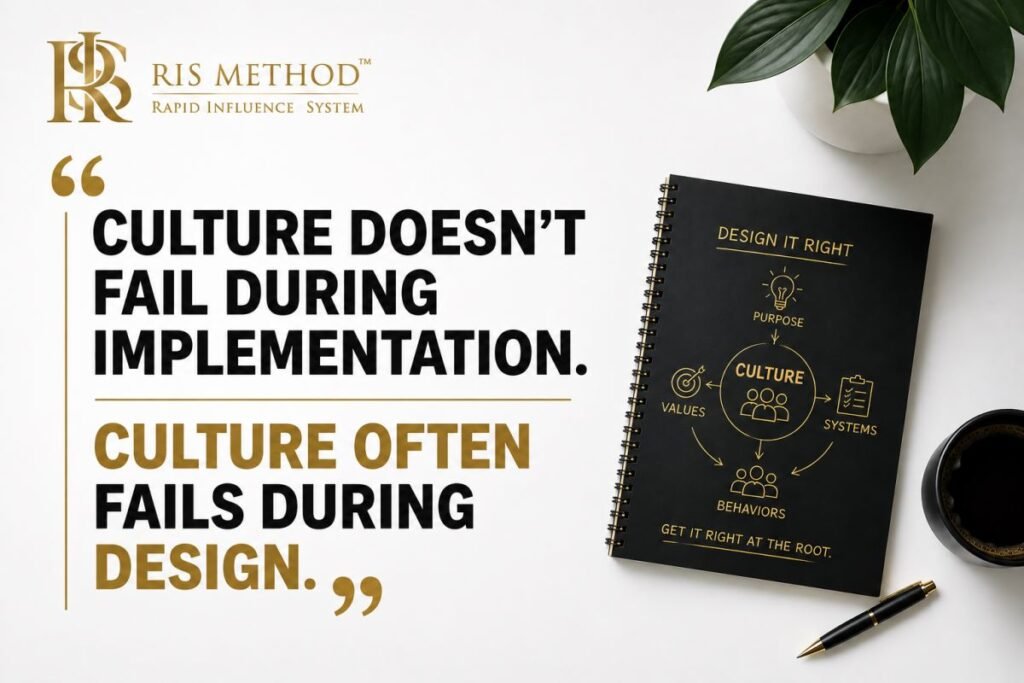
The second recognizes that engagement is an organizational design problem.
If your people don’t use your product, why?
If your leadership team waits for you to make every decision, why?
If the energy disappears when senior leadership enters the room, why?
If people protect themselves instead of helping one another, why?
If suppliers and customers experience your organization as transactional rather than relational, why?
Those questions lead you toward the real source of leadership friction.
And that’s where meaningful change begins.
Diagnose the Friction Before It Becomes a Crisis
Sometimes the problem isn’t that your people are lazy.
Sometimes your culture isn’t “broken.”
Sometimes the organization has accumulated friction that leaders can’t see from the executive suite.
Decision bottlenecks.
Poor communication.
Leadership dependency.
Low trust.
Misaligned incentives.
Weak accountability.
Disconnected teams.
Cultural contradictions.
These problems create organizational lag long before they appear in financial results.
That’s why leaders need to diagnose the source of the friction, not simply react to its symptoms.
Get Your Leadership Friction Diagnosis Autopsy
If you’re a CEO, founder or senior leader who wants to understand what’s creating friction or lag in your corporate culture or leadership style, use the Leadership Friction Diagnosis Autopsy Tool.
The self-help AI tool helps you identify potential sources of leadership and cultural friction and provides real-time recommendations based on your results.
Get access to the Leadership Friction Diagnosis Autopsy Tool →
Because the goal isn’t simply to build a company where people work.
The goal is to build an ecosystem where people care.
And when people care, engagement stops being something you have to demand.
It becomes something they naturally create.