
The 3 A.M. CEO Test: The One Leadership Question That Reveals If You've Built a Company or Just an Expensive Job
If You Disappeared Tomorrow, What Would Happen?
There is one question that exposes the true health of an organization faster than any financial report, strategic plan, or organizational chart.
It isn’t about revenue.
It isn’t about profit.
It isn’t even about growth.
Instead, ask yourself this:
If you disappeared tomorrow, no phone, no email, no contact, for two weeks, what would actually happen to your company?
Not what you hope would happen.
Not what your executive team would tell the board.
What would really happen?
The answer reveals whether you’ve built an organization capable of thriving independently or one that depends entirely on you.
For founders and CEOs, this may be the most uncomfortable leadership question you’ll ever answer.
It may also be the most important.
The Hidden Leadership Trap Most CEOs Never See
Many founders unknowingly become the center of every important decision.
Every major client relationship.
Every strategic initiative.
Every difficult problem.
Every escalation.
At first, this feels like strong leadership.
Eventually, it becomes the organization’s greatest weakness.
When every important decision requires the CEO, the company cannot operate at its full potential.
Growth slows.
Decision-making bottlenecks emerge.
Leaders stop leading because they’re waiting for approval.
Innovation declines because people become conditioned to ask instead of think.
Ironically, the more capable the founder is, the worse this problem often becomes.
Exceptional leaders frequently create organizations that rely too heavily on their exceptional abilities.
Their strengths become the organization’s constraint.
The CEO Drag
Many companies suffer from what can be described as CEO Drag, the hidden friction created when the organization’s momentum depends on one individual.
It rarely appears on financial statements.
Yet it affects nearly every performance metric:
- Slower execution
- Leadership dependency
- Reduced innovation
- Poor succession readiness
- Lower enterprise value
- Founder burnout
The organization appears successful.
Behind the scenes, however, progress slows whenever decisions have to move through one person.
The CEO unintentionally becomes the organization’s largest bottleneck.
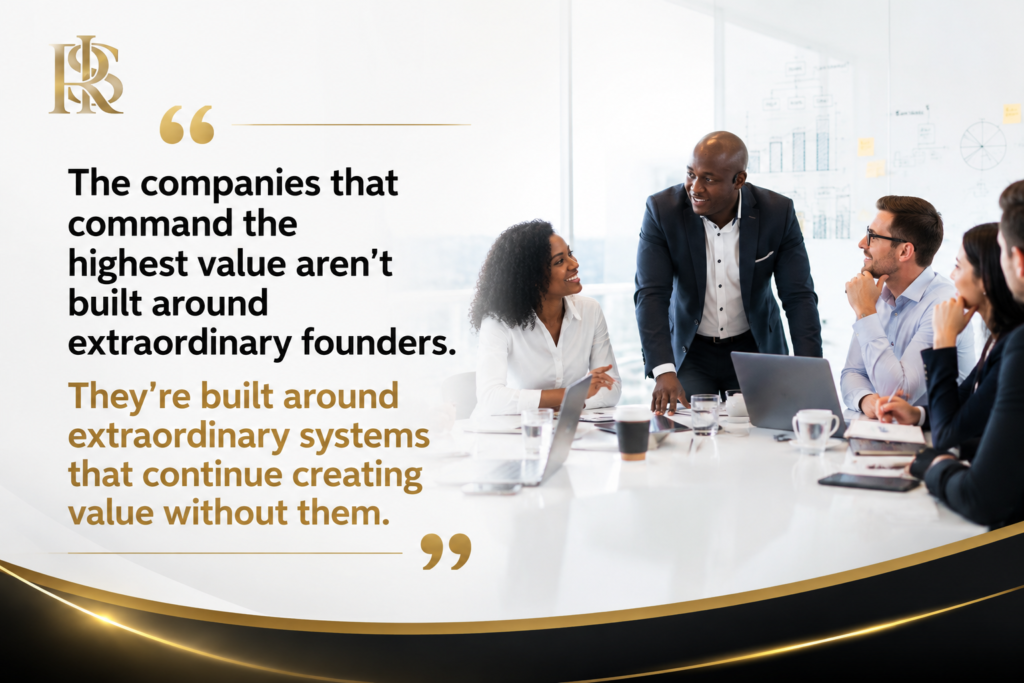
The companies that command the highest value aren't built around extraordinary founders—they're built around extraordinary systems that continue creating value without them.
The Two-Week Freedom Test
Imagine taking two weeks completely away from your company.
No laptop.
No calls.
No emails.
No emergency text messages.
Could your leadership team continue making high-quality decisions?
Would clients notice you were gone?
Would projects continue moving?
Would new ideas emerge?
Most importantly…
Would the company actually improve while you were away?
This is a far higher standard than simply surviving your absence.
A resilient organization doesn’t merely function without the CEO.
It becomes stronger because capable leaders are trusted to lead.
When executives have room to make decisions, ownership increases.
Innovation accelerates.
Future leaders emerge.
The CEO returns to a healthier business than the one they left.
That is the difference between building a company and creating a job with a prestigious title.
When every important decision ends with the CEO, the organization's greatest asset quietly becomes its greatest source of friction.
Why Brilliant CEOs Often Create Fragile Organizations
One of the greatest paradoxes in leadership is this:
The better the founder, the more dependent the company often becomes.
Why?
Because brilliant leaders solve problems quickly.
They make excellent judgments.
They see opportunities others miss.
They naturally become the person everyone consults.
Eventually, people stop solving problems independently.
Instead, they wait.
The organization adapts around the CEO instead of developing its own decision-making capability.
Without realizing it, leadership excellence creates organizational dependence.
Brilliance becomes the ceiling rather than the catalyst for growth.
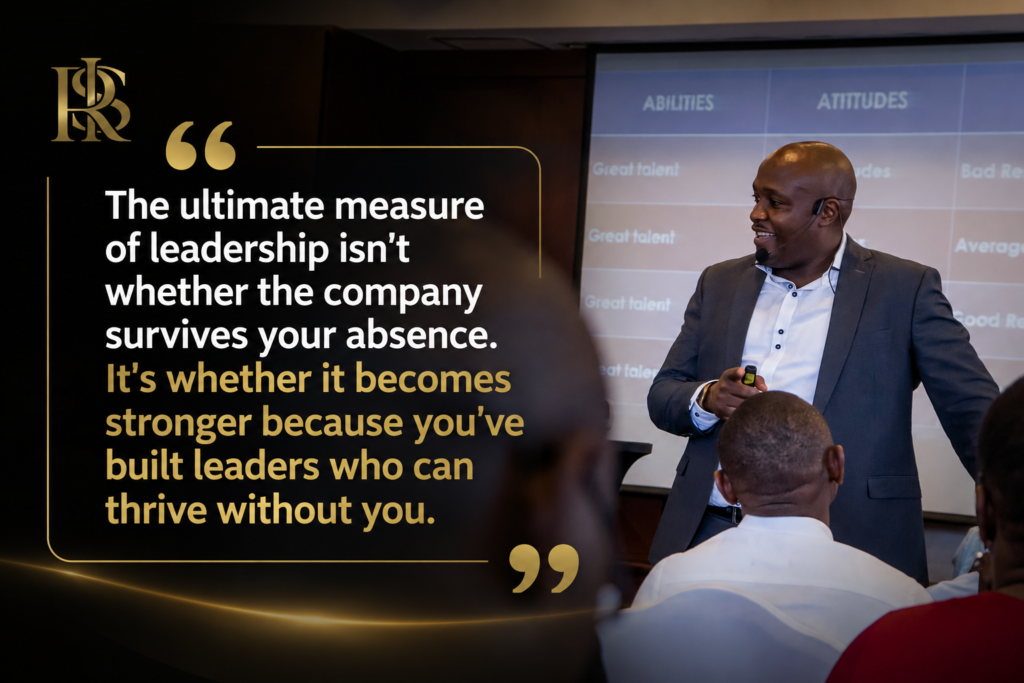
The ultimate measure of leadership isn't whether the company survives your absence—it's whether it becomes stronger because you've built leaders who can thrive without you.
Enterprise Value Depends on Independence
Sophisticated investors don’t simply evaluate financial performance.
They evaluate organizational resilience.
Can this business continue growing without its founder?
Can leadership scale?
Can decisions happen at every level?
Is the executive team capable of driving performance independently?
Organizations heavily dependent on one individual often receive lower valuations because they carry significantly more operational risk.
If removing one person dramatically impacts business performance, investors recognize the business has not yet matured.
The most valuable organizations are those where leadership is distributed not centralized.
The Best Leaders Build Decision-Makers
Exceptional CEOs don’t seek to be indispensable.
They intentionally build people who no longer depend on them.
They recruit strong leaders.
They create clear decision frameworks.
They establish accountability.
They empower intelligent risk-taking.
Instead of becoming the answer to every question, they create an environment where great questions are answered throughout the organization.
The result is faster execution.
Higher engagement.
Greater innovation.
Stronger leadership pipelines.
And significantly more organizational capacity.
Leadership Is a Decision Problem
Many executives believe their challenges stem from organizational structure or company culture.
Those factors matter.
But underneath both lies something deeper.
A decision system.
When decisions consistently move upward, organizational friction increases.
When decisions move outward through capable leaders, organizations become agile.
The role of the CEO evolves from solving every problem to designing the system that solves problems.
That shift changes everything.
The Freedom Every Founder Wants
Most entrepreneurs begin with a vision of freedom.
The freedom to create.
To build.
To lead.
Ironically, many eventually create a business that owns them instead.
Their calendar controls them.
Their phone controls them.
Their team depends on them.
Their company cannot breathe without them.
True executive freedom is not working fewer hours.
It is building an organization capable of creating value independently.
That is the mark of mature leadership.
Ask Yourself the Question Tonight
Before your next board meeting…
Before your next strategic planning session…
Before your next quarterly review…
Ask yourself one honest question:
If I disappeared for two weeks, what would really happen?
Your answer reveals more about your organization’s health than almost any KPI.
If the business grows stronger without you, you’ve built something truly valuable.
If everything waits for your return, you’ve identified the next stage of your leadership journey.
The good news is that this isn’t a permanent condition.
With intentional leadership design, stronger decision systems, and empowered executives, organizations can transition from founder-dependent to founder-enabled.
That transformation creates more freedom, more value, better leadership, and a company capable of thriving for decades.
Final Thought
Leadership isn’t about becoming more indispensable.
It’s about making your organization less dependent on you.
When your team can think independently, make confident decisions, and drive innovation without constant oversight, you’ve created something far more valuable than a successful company, you’ve built a lasting institution.
Ready to discover where leadership friction is limiting your organization?
Get free access to the leadership friction analysis tool at: