
The Hidden CEO Bottleneck: How Decision Dependency Is Quietly Costing Companies Millions (And How to Eliminate It)
Every successful company reaches a point where its greatest competitive advantage can quietly become its greatest liability.
Ironically, that liability is often the CEO.
Not because the CEO lacks capability.
Not because the CEO is making poor decisions.
But because the entire organization has unconsciously learned that almost every important decision must flow through one individual.
This phenomenon is what we call CEO Drag, a form of leadership friction that slows execution, reduces accountability, frustrates talented leaders, and silently limits organizational growth.
Whether you’re leading a Fortune 500 company in the United States, a fast-growing enterprise in Kenya, a manufacturing business in South Africa, or a technology company in Nigeria, Uganda, or Ghana, the pattern is remarkably consistent.
The company grows.
The complexity grows.
But the leadership architecture never evolves.
Eventually, the CEO becomes the bottleneck.
A 72-Hour Observation That Changed Everything
During a leadership intervention for a multi-billion-dollar international organization, I decided to do something different.
Instead of facilitating another executive strategy retreat, I spent 72 hours shadowing the CEO.
No workshops.
No presentations.
No assumptions.
Just observation.
For three days, I documented every decision that reached the CEO’s desk.
Every approval.
Every question.
Every request for guidance.
Every judgment call.
The result was startling.
In just 72 hours:
- 47 decisions reached the CEO.
- Only 11 genuinely required the CEO’s authority, expertise, or strategic insight.
- 36 decisions should never have reached the CEO in the first place.
That means over 75% of executive attention was consumed by work someone else was fully capable of doing.
The issue wasn’t competence.
It was culture.
A company rarely grows beyond the speed of its decision-making architecture.
The Real Cost of CEO Drag
Many leaders assume these approval requests only cost a few minutes.
In reality, the cost multiplies across the organization.
One example illustrates this perfectly.
The company had hired one of the world’s leading health and safety experts.
Highly experienced.
Internationally respected.
Fully qualified.
Yet this expert waited outside the CEO’s office for nearly two hours seeking approval on a matter that fell squarely within his professional responsibility.
While waiting:
- Construction work stalled.
- Contractors left the site.
- Production schedules shifted.
- Teams remained idle.
The result?
Nearly three days of operational delay.
An estimated $500,000 in lost productivity.
Not because nobody knew what to do.
Because everyone believed only the CEO could authorize it.
Leadership Friction Is an Organizational Design Problem
Most CEOs don’t intentionally create dependency.
In fact, many are exceptional leaders.
The problem emerges because organizations evolve faster than their decision-making systems.
As businesses grow:
- More people are hired.
- More departments are created.
- More revenue is generated.
- More complexity appears.
Yet approvals continue following the same pathways established years earlier.
Every decision keeps climbing upward.
Eventually, the CEO becomes the center of every workflow.
The organization slows.
Innovation declines.
Accountability weakens.
High performers become frustrated because they are trusted to execute but not trusted to decide.
If your experts constantly wait for your approval, you haven't built empowerment—you've built dependency.
The Hidden Cost CEOs Never Measure
Most CEOs track:
- Revenue
- EBITDA
- Customer acquisition
- Cash flow
- Productivity
- Market share
Few measure decision velocity.
Yet decision velocity often determines organizational speed.
Every unnecessary approval creates invisible costs:
- Delayed projects
- Slower innovation
- Missed opportunities
- Reduced customer responsiveness
- Executive burnout
- Frustrated middle management
- Lower employee engagement
Most importantly…
Every minute a CEO spends making someone else’s decision is a minute not spent on:
- Strategy
- Growth
- Partnerships
- Innovation
- Talent development
- Market expansion
- Investor relationships
For companies operating in increasingly competitive markets across both Africa and North America, this opportunity cost can become enormous.
The strongest CEOs aren't the ones making the most decisions. They're the ones building organizations that don't need them for every decision.
The CEO Gap
At RIS Method, we call this leadership blind spot The CEO Gap.
It is the measurable distance between Decisions that truly require executive leadership and Decisions that unnecessarily depend on executive approval.
Closing this gap unlocks:
- Faster execution
- Better accountability
- Stronger leadership teams
- Higher employee ownership
- Improved operational efficiency
- Greater organizational agility
Companies don’t become scalable because CEOs work harder.
They become scalable because leaders intentionally redesign how decisions are made.
A Simple Leadership Exercise
If you want to uncover hidden leadership friction inside your organization, try this exercise.
For the next three days, have your Executive Assistant or Chief of Staff record every decision that reaches your desk.
Track:
- Every approval request
- Every question
- Every escalation
- Every meeting requiring your decision
Then ask one question:
“Did this truly require me?”
You may discover that the majority of your time is being consumed by decisions your leadership team could and should be making.
That insight alone can transform your company’s operating model.
High-Performance Organizations Scale Through Trust
World-class companies are not built on heroic CEOs.
They are built on empowered leadership systems.
The role of the CEO is not to become involved in every decision.
It is to design an organization capable of making excellent decisions without constant executive intervention.
When leadership friction is removed:
- Execution accelerates.
- Teams become more confident.
- Innovation increases.
- Customers receive faster service.
- The CEO regains time for strategic leadership.
That is how organizations become truly scalable.
Is Your Leadership Team Waiting on You?
If your calendar is overloaded…
If every important decision seems to require your approval…
If your leadership team frequently says,
"We were waiting for you..."
then your organization may be experiencing measurable CEO Drag.
The good news?
Leadership friction can be measured.
More importantly – it can be eliminated.
Discover Your Leadership Friction Score Today
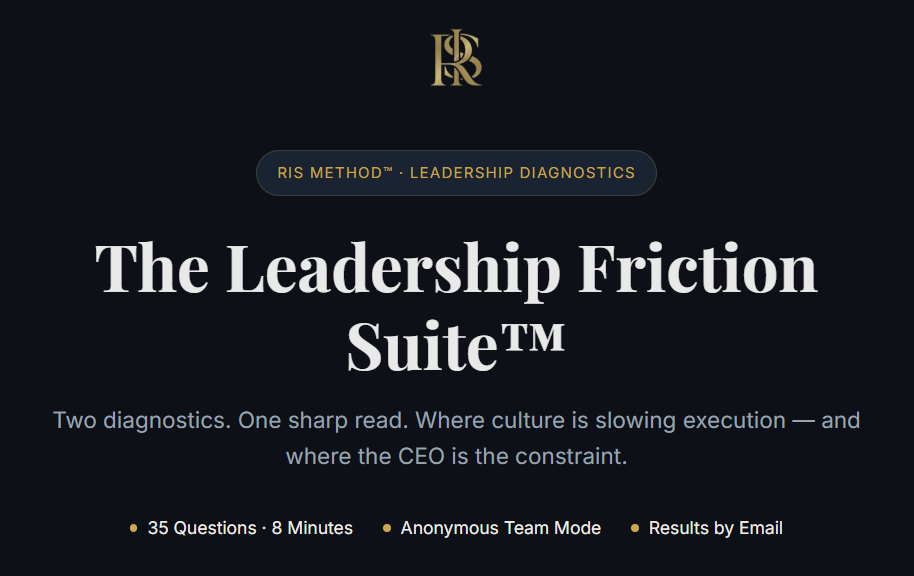
The RIS Method Leadership Friction Diagnostic helps CEOs, founders, executive teams, and business owners identify the hidden leadership bottlenecks that slow growth, reduce accountability, and limit organizational performance.
By completing the assessment, you’ll gain practical insights into where decision dependency exists and what actions will help your leadership team operate with greater speed, confidence, and effectiveness.
👉 Start your free Leadership Friction Diagnostic today:
https://rismethod.com/leadership-friction-suite/
Your next level of growth may not require better strategy.
It may simply require removing the friction that’s already slowing your organization down.