
Why CEOs Only Hear About Problems When It's Too Late.
Every CEO wants transparency.
Every executive says they have an open-door policy.
Yet many leaders only discover major problems after they’ve become expensive, public, or impossible to reverse.
The natural assumption is that people failed to communicate.
In reality, something very different is happening.
Your leadership team is often filtering information not because they are dishonest, but because your leadership has trained them to do so.
The most dangerous organizational behavior isn’t deception.
It’s learned concealment.
Every Leadership Team Has an Invisible Function
Organizations have an unofficial role that never appears on an organizational chart:
Information filtering.
Every day your executives make unconscious decisions about questions like:
- Is this worth escalating?
- Will the CEO overreact?
- Is it safer if I solve this myself?
- Will raising this issue make me look incompetent?
Those calculations happen continuously.
Eventually your organization stops bringing you early warnings.
Instead, it only brings you crises.
How CEOs Accidentally Train Their Teams
It rarely begins with shouting.
In fact, most CEOs never intend to discourage transparency.
The process usually looks like this.
A vice president raises an early issue.
The CEO immediately responds:
Why didn't you catch this earlier?
Or perhaps they sigh.
Or challenge assumptions.
Or rapidly interrogate details.
None of these reactions appear hostile.
But they communicate one powerful message:
Bringing problems to leadership has a cost.
Next time, that executive waits.
They attempt to solve it privately.
Eventually they escalate only when there are no options left.
At that point the CEO concludes:
“Why does nobody tell me anything?”
The answer is simple.
Because they learned not to.
This Isn't a Communication Problem
Many organizations try solving this issue with:
- trust workshops
- vulnerability training
- psychological safety discussions
- values posters
- leadership retreats
Those initiatives can be valuable.
But they rarely address the real issue.
People aren’t calculating trust.
They’re calculating consequences.
Every escalation runs through a simple internal equation:
What will it cost me if I bring this to the CEO?
Until that equation changes, behavior won’t.
A Real Executive Example
One industrial services company generated approximately $38 million in annual revenue with around 140 employees.
Its CEO genuinely believed he had created an open-door culture.
His operations leader disagreed.
During leadership meetings, every issue raised was immediately challenged with rapid questions and instant solutions.
The CEO believed he was demonstrating engagement.
The operations executive experienced exposure.
Over time he stopped raising issues publicly.
Instead, he quietly attempted to solve everything himself.
Eventually a critical supplier contract renewal slipped through the cracks.
A supplier relationship that had taken four years to build disappeared almost overnight.
When the situation was reviewed later, the organization identified the exact meeting where the executive unconsciously decided:
“I’m not bringing difficult issues into leadership meetings anymore.”
The financial loss wasn’t caused by incompetence.
It was caused by filtering.
The Real Cost of Leadership Filtering
When executives stop escalating issues early:
- Risks grow silently.
- Decisions become reactive.
- Opportunities disappear.
- Teams operate in isolation.
- CEOs lose visibility into reality.
Instead of solving small problems, leaders spend their time managing expensive emergencies.
Research discussed in the presentation aligns with a common executive pattern:
Most CEOs spend the majority of their time reacting to issues that surface late rather than preventing them while they are still manageable.
Reactive leadership is often the downstream result of organizational filtering.
The Five-Incident Leadership Audit
A simple diagnostic exercise can reveal whether you are unintentionally creating concealment.
Review the last five occasions when someone escalated an issue before it became a crisis.
Ask yourself:
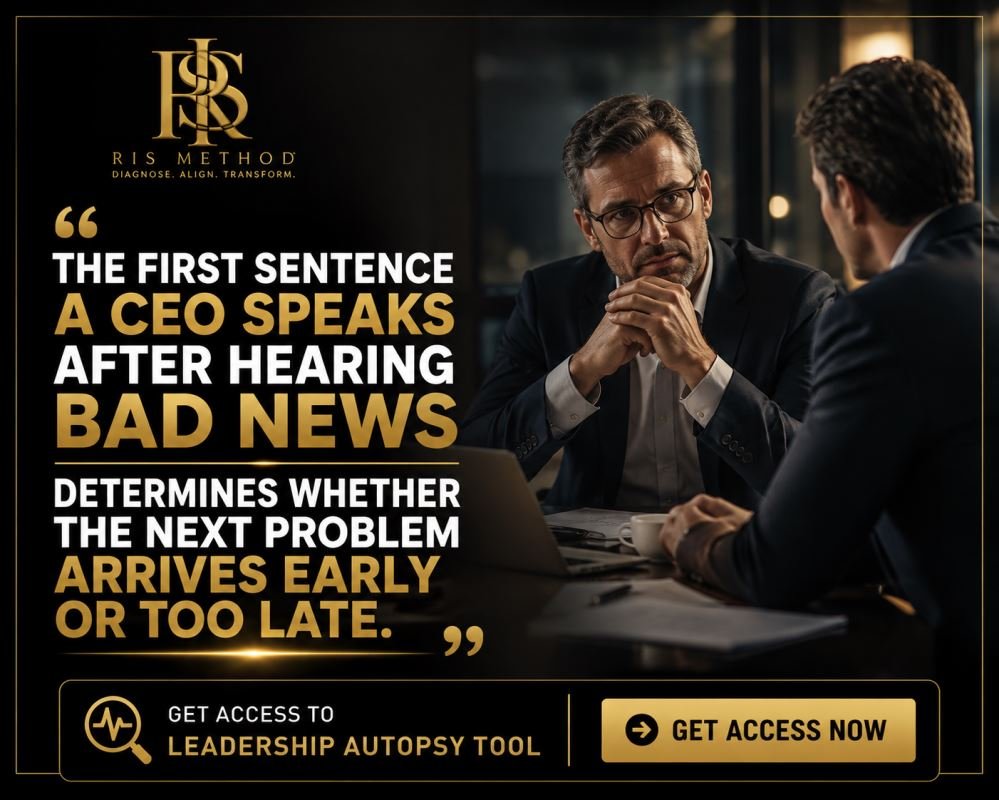
What was my very first response?
Was it:
Thank you for bringing this.
Or was it:
Why didn't you catch this earlier?
That first sentence matters more than leaders realize.
If your first response focuses on the problem, you encourage future escalation.
If your first response focuses on the person, you encourage future concealment.
Your leadership team remembers the emotional experience not your intentions.
Replace Interrogation with Reinforcement
Changing organizational behavior doesn’t require another leadership program.
It requires consistent reinforcement.
For the next eight weeks, whenever someone raises an early-stage issue:
Start with:
Thank you for bringing this to me.
Only then begin asking:
- Walk me through it.
- What support do you need?
- What options have you considered?
- How can we solve this together?
This simple sequence changes the psychological equation.
People learn that escalating problems is rewarded rather than punished.
Over time, earlier warnings become normal.
Great CEOs Don't Eliminate Problems
They discover them sooner.
Organizations that consistently outperform competitors aren’t free of mistakes.
They simply surface mistakes while they’re still inexpensive to fix.
That’s the competitive advantage.
The goal isn’t perfect execution.
The goal is creating a leadership system where reality reaches the CEO before it becomes a crisis.
Because diagnosis always comes before prescription.
Without accurate diagnosis, leadership becomes reactive and reactive organizations eventually pay the price.
Discover What's Really Slowing Your Leadership Team
If you’re a CEO, founder, executive, or senior leader looking to strengthen execution, improve culture, and uncover the hidden friction limiting organizational performance, start with an objective diagnosis.
Use the Leadership Friction Diagnosis Autopsy Tool, an AI-powered assessment that helps leaders identify the sources of friction within their leadership style and organizational culture—and provides real-time recommendations tailored to their results.
Start your free Leadership Friction Diagnosis Autopsy here:
https://rismethod.com/leadership-friction-suite/
Because the right prescription only comes after the right diagnosis.