
Your KPIs Are Lying to You: The Hidden Enterprise Value Risks That Can Destroy Your Company's Sale Price
For years, executives have been taught that if revenue is growing, margins are improving, customer churn is low, and operational dashboards are green, then the business is healthy.
That advice is only half true.
Your operational KPIs may tell you how well your company is performing today but they reveal almost nothing about what your company is actually worth tomorrow.
This distinction becomes painfully obvious the moment you enter an acquisition process.
I’ve sat in multiple exit rooms where CEOs confidently presented dashboards filled with green metrics. Revenue was climbing. Profitability was strong. Customer retention looked excellent.
Yet when buyers began their due diligence, valuations fell dramatically.
Not because the companies were poorly run.
Because the dashboards were measuring the wrong things.
The scorecard wasn’t lying.
It was simply answering the wrong question.
Every CEO Has Two Dashboards
Most organizations spend years perfecting one dashboard.
The management dashboard.
It answers questions like:
- Are revenues increasing?
- Are margins improving?
- Is our sales pipeline healthy?
- Are customers staying?
- Are operations efficient?
These metrics are essential.
They help leadership operate the business.
But buyers don’t purchase your past.
They purchase your future.
Specifically…
They purchase the future of your company without you in it.
That requires an entirely different scorecard.
Your KPI dashboard measures how well you manage today. Enterprise value measures how well your company survives tomorrow.
Buyers Measure Risk. CEOs Measure Performance.
When investors evaluate a business, they are not asking:
“How well did this company perform last quarter?”
They’re asking:
- What happens if the founder disappears?
- Who owns the customer relationships?
- Does leadership exist beyond the CEO?
- Can the business continue growing independently?
- Is this organization scalable or is it personality-driven?
These questions determine enterprise value.
Yet almost no CEO tracks them.
The KPI That Never Appears on Your Dashboard
One of the biggest hidden risks is something private equity firms call Key Person Risk (often called “Key Man Risk”).
It occurs when too much value is concentrated in one individual.
Usually…
The CEO.
The founder.
The owner.
The rainmaker.
The person every important client trusts.
The person everyone calls first.
Ironically, the more indispensable you become, the less valuable your company often becomes.
The more your customers depend on you personally, the less valuable your company becomes to a buyer.
A Real Example
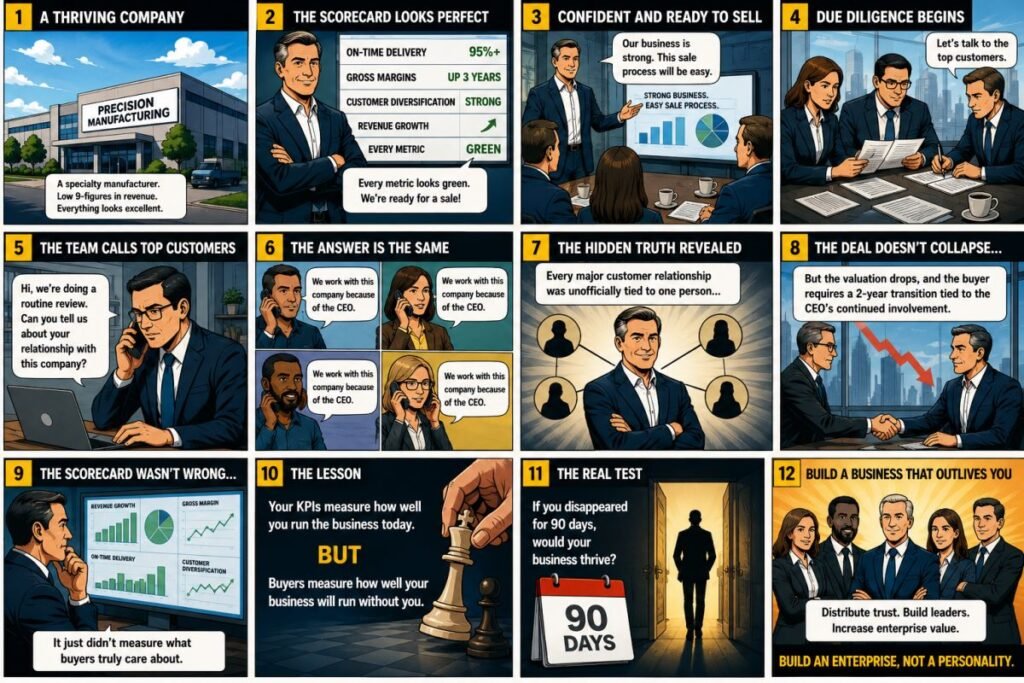
One specialty manufacturing company generated well into nine figures of annual revenue.
Everything looked exceptional.
- On-time delivery exceeded expectations.
- Gross margins improved for three consecutive years.
- Customer concentration was diversified.
- Every operational metric appeared healthy.
The CEO believed the company was ready for sale.
Then due diligence began.
The buyer contacted several of the company’s largest customers.
The responses were remarkably similar.
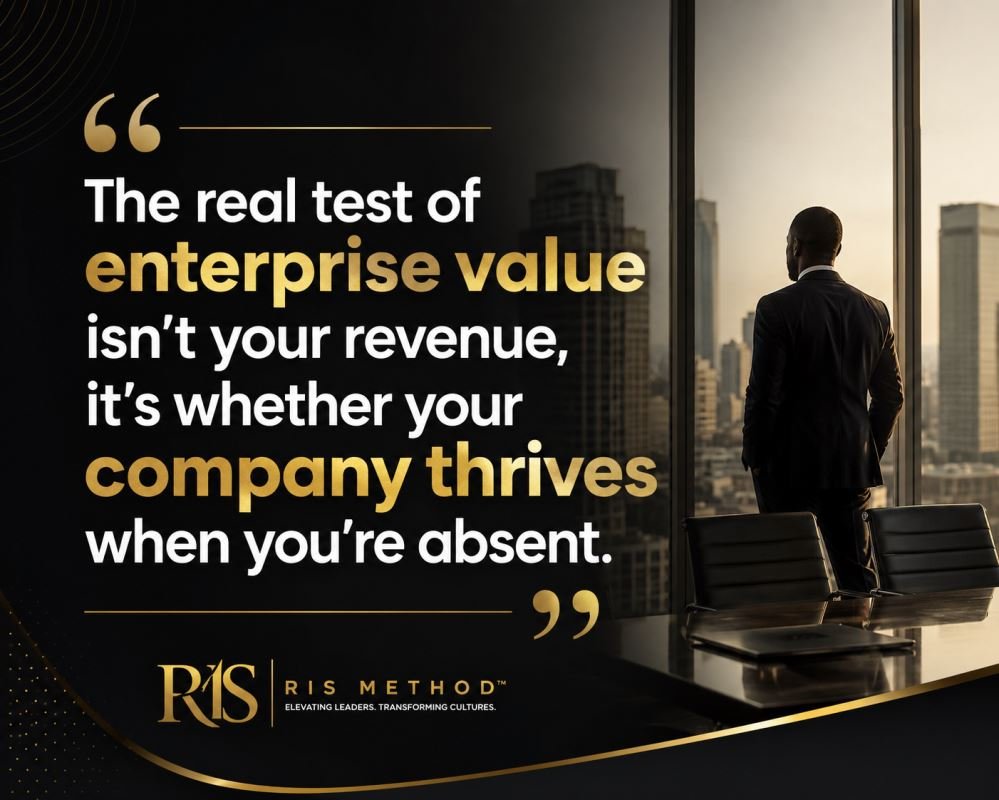
Great leadership doesn't eliminate dependency by accident, it engineers trust into the entire organization
Although the organization had sales executives, account managers, customer success teams and modern CRM systems, the buyers discovered something the dashboard never measured.
The relationships belonged to one person.
The CEO.
The business had systems.
But the trust did not.
The deal didn’t collapse.
But the valuation did.
The buyer reduced the purchase price and required a two-year transition period tied directly to customer retention and continued CEO involvement.
The operational KPIs stayed green.
Enterprise value dropped anyway.
Why This Happens So Often
Traditional dashboards focus on efficiency.
Acquirers focus on dependency.
Those are two completely different conversations.
A company can operate brilliantly while still carrying enormous hidden risk.
That risk only becomes visible when buyers ask uncomfortable questions.
Questions many advisors never raise until it’s too late.
Run the 90-Day Relationship Test
Here’s a simple exercise every CEO should complete this week.
Identify your eight most important relationships.
These could include:
- Largest customers
- Strategic suppliers
- Government contacts
- Key partners
- Major investors
Now ask one brutally honest question:
If I disappeared for the next 90 days, would this relationship remain just as strong?
If the answer is “no,” you’ve discovered an enterprise value problem.
Not a sales problem.
Not a marketing problem.
A leadership problem.
Transfer Relationship Equity Before You Need To
Fortunately, fixing Key Person Risk isn’t complicated.
It requires intentional leadership.
Begin introducing senior team members into every important relationship.
Take them to meetings.
Allow them to lead conversations.
Let customers develop confidence in people other than you.
Over time, transition authority, not just responsibility.
The goal isn’t to remove relationships.
It’s to distribute trust.
When clients trust the organization instead of the founder, enterprise value increases dramatically.
Building a Business That Outlives You
Reducing dependency isn’t only valuable for future acquisitions.
It creates healthier organizations today.
Your team gains confidence.
Future leaders emerge.
Decision-making improves.
Customers experience greater stability.
Innovation accelerates.
Most importantly…
Your company becomes an enterprise instead of a personality.
That’s the difference between owning a successful business and building a valuable one.
The Leadership Question Every CEO Should Ask
Your management dashboard tells you how well you’re running the business today.
But here’s the question it never answers:
What is this company worth if I’m no longer in the room?
The answer to that question determines your true enterprise value.
If you don’t know the answer, now is the time to find out.
Diagnose the Hidden Friction Holding Your Organization Back
Most leadership problems don’t begin with strategy.
They begin with invisible friction.
That’s why we’ve developed the Leadership Friction Diagnosis Autopsy Tool, an AI-powered self-assessment that helps CEOs identify the hidden leadership, cultural, and structural bottlenecks slowing organizational growth.
The tool provides real-time insights and practical recommendations based on your responses, helping you reduce leadership friction, strengthen succession readiness, and build a more valuable enterprise.
Get your free Leadership Friction Diagnosis Autopsy here:
https://rismethod.com/leadership-friction-suite/
Because the greatest companies aren’t measured only by today’s performance.
They’re measured by how well they perform without depending on one person.