
The Dark Truth About Corporate Consulting: Reports Don't Create Results
For many CEOs and founders, hiring a consultant feels like a smart leadership decision.
Sometimes, it is.
But sometimes, the real reason a consultant gets hired is far more uncomfortable: the leader already knows what needs to be said or done and wants someone else to say it.
That distinction can cost companies millions.
A consultant can either become the catalyst for meaningful change or become the person whose report gives leadership a convenient place to point when difficult decisions need to be explained.
The difference is not the quality of the presentation.
It is what happens after the presentation.
Why Do So Many Consultant Reports End Up in a Drawer?
Imagine a boardroom.
A consultant walks in, delivers a sophisticated presentation, outlines the organizational problems, identifies risks, and recommends a series of initiatives.
Everyone nods.
The report is circulated.
The board discusses it.
And then… nothing meaningful changes.
Months later, someone asks, “What did the consultants recommend?”
The report is pulled out.
It becomes a reference document.
Perhaps someone even says, “According to the consultants, we should have done X.”
But the organization still has the same problem.
This raises an important question for every CEO:
Did you hire the consultant to create insight or to create accountability?
Because those are two very different things.
Sometimes leadership does not need more information.
It needs the courage to act on information it already has.
The Consultant Should Not Be Your Corporate Alibi
There is a dangerous use of consulting that executives rarely discuss openly.
The consultant becomes corporate camouflage.
A difficult decision is easier to defend when it appears in a report with a respected consulting firm’s name and logo.
Instead of saying:
“We decided this because I believe it is necessary,”
a leader can say:
“The consultants recommended it.”
That can feel safer.
It can also be incredibly expensive.
A consultant should help leaders see what they cannot see, not provide them with a professional excuse to avoid saying what they already know.
That is particularly important in founder-led and owner-led organizations.
In these businesses, the organization often eventually reaches the same bottleneck:
the founder or CEO.
The CEO is involved in every major decision.
Every issue escalates upward.
Every disagreement waits for executive intervention.
Every important relationship depends on the founder.
And everyone outside the company can see the bottleneck except the person sitting in the bottleneck.
Yet many external advisors will be reluctant to put that truth on a slide.
Why?
Because confronting the CEO can be commercially uncomfortable.
But leadership effectiveness is not about making the client comfortable.
It is about creating results.
The Transformation Paradox
There is another question executives should ask before signing a consulting contract.
If organizations regularly struggle to execute transformations successfully, why does the consulting industry continue to grow?
The answer deserves serious reflection.
Consulting creates enormous value when expertise is connected to execution, accountability, behavioral change and measurable outcomes.
But advice by itself does not create transformation.
A strategy sitting in a PowerPoint does not transform a company.
A diagnosis does not transform a company.
A 100-page report does not transform a company.
Execution transforms companies.
That means CEOs should stop evaluating advisors primarily on the sophistication of their recommendations.
Instead, evaluate them on what happens after the recommendation is made.
Will they help you implement it?
Will they challenge your assumptions?
Will they stay engaged when resistance appears?
Will they confront the people including the CEO who are blocking progress?
Will they understand the psychology behind the organization, not just its organizational chart?
Those questions matter far more than the quality of the slides.
The Enron Lesson: A Perfect Model Can Still Produce a Disaster
Enron is a powerful reminder that sophisticated organizations can still collapse when risk, incentives, leadership behavior and accountability become disconnected.
The presence of smart people, consultants, frameworks and projects does not automatically create sound decision-making.
You can have the best strategy in the room and still make terrible decisions.
You can have brilliant advisors and still have organizational dysfunction.
You can have an enormous transformation program and still fail to address the human behaviors creating the problem.
The lesson for today’s CEO is simple:
Complexity is not the same thing as effectiveness.
A sophisticated diagnosis is worthless if nobody is prepared to act on it.
“The future belongs to CEOs who can turn operational noise into strategic intelligence.”
When You Actually Need a Consultant
The answer is not to stop using consultants.
It is to become much more intentional about why you are using them.
There are situations where outside expertise is invaluable.
An effective consultant can enter an organization with fresh perspective, experience from comparable situations, specialized expertise and the courage to challenge assumptions that have become invisible to insiders.
The best consultants are not simply analysts.
They are operators.
They understand what happens after the boardroom presentation.
They understand that change gets messy.
They understand organizational politics, incentives, psychology and human behavior.
Most importantly, they understand execution.
A CEO should be able to ask:
“Are you here to tell me what I don’t know, or are you here to help me do what I know needs to be done?”
That question can completely change the value of the engagement.
Stop Buying Advice. Start Buying Outcomes.
Before you spend six figures on a consulting engagement, ask yourself three questions.
What problem am I actually trying to solve?
Not the problem that sounds good in a board presentation.
The real problem.
What do I already know about this problem?
Be brutally honest.
What have you been avoiding?
What conversation have you postponed?
What decision are you afraid to make?
What person is consistently creating friction?
What behavior have you tolerated for too long?
What will happen differently after the consultant leaves?
This is perhaps the most important question of all.
Because if the answer is “we will have a report,” the engagement may already be doomed.
The outcome should be something measurable:
A decision gets made.
A leadership behavior changes.
A dysfunctional process gets removed.
An executive is held accountable.
A team starts operating differently.
A strategic bottleneck is eliminated.
A culture begins reinforcing a different standard.
That is consulting that creates value.
The CEO Problem Nobody Wants to Put on the Slide
There is an uncomfortable leadership truth that every founder eventually has to confront:
The person with the greatest authority in the organization can also become its greatest constraint.
That does not mean CEOs are bad leaders.
It means organizations naturally adapt around their leaders.
If the CEO centralizes decisions, people wait.
If the CEO tolerates mediocre performance, people normalize it.
If the CEO avoids difficult conversations, the organization learns avoidance.
If the CEO constantly changes priorities, teams learn to stop committing fully to anything.
If the CEO becomes the final approval point for everything, organizational agility disappears.
The culture is often a mirror of what leadership repeatedly permits, rewards and reinforces.
No consultant can fix that without the CEO’s willingness to confront it.
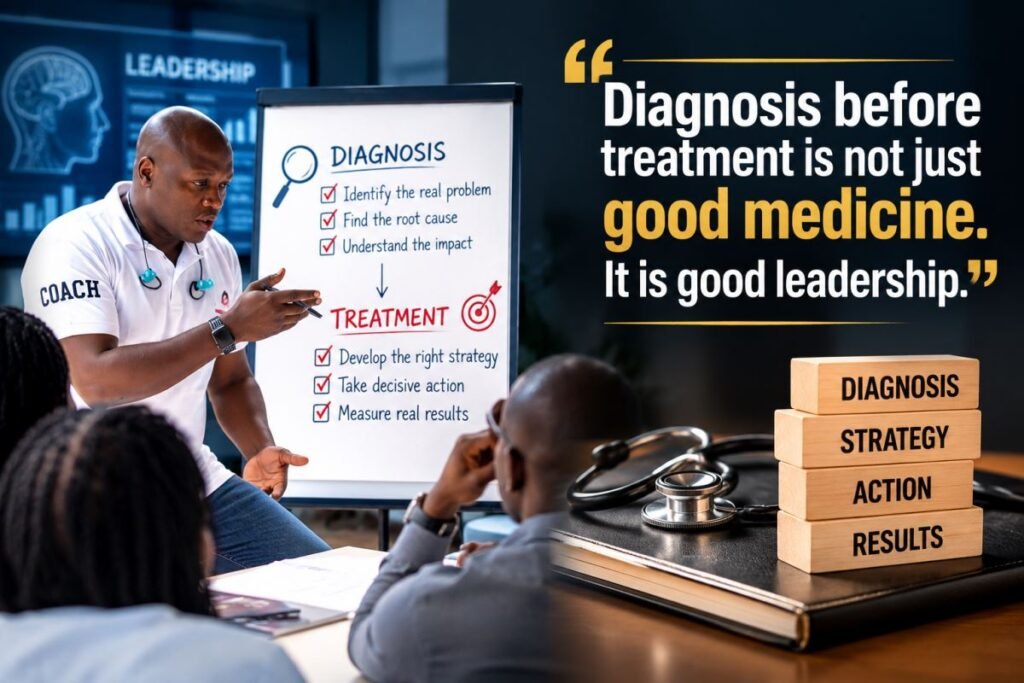
Diagnosis Before Treatment
There is a reason medical professionals diagnose before prescribing treatment.
Leadership should work the same way.
Too many organizations jump from “something feels wrong” directly to:
“Let’s hire consultants.”
“Let’s restructure.”
“Let’s change the leadership team.”
“Let’s launch a transformation.”
“Let’s run a training program.”
But what if the real issue is somewhere else?
What if the friction is coming from decision-making?
What if it is middle management?
What if incentives are misaligned?
What if the executive team is competing instead of collaborating?
What if the founder has become the bottleneck?
What if the organization doesn’t have a strategy execution problem at all but a leadership behavior problem?
Without diagnosis, organizations can spend enormous amounts of money treating the symptom while leaving the cause untouched.
Diagnosis before treatment is not just good medicine. It is good leadership.
Find the Friction Before You Try to Fix the Organization
One of the most useful questions a CEO can ask is:
“Where is the friction preventing this organization from performing at the level it should?”
The Leadership Friction Diagnosis Autopsy Tool was designed to help leaders begin answering that question.
It is a self-help AI tool that helps leaders identify potential sources of friction or lag in their leadership style or corporate culture and provides suggested remedies based on the results.
Instead of immediately buying another consulting engagement, start by diagnosing the problem.
Understand where the friction may be coming from.
Identify what could be slowing your leadership team down.
Then decide what level of intervention is actually required.
Get Your Leadership Friction Diagnosis
Access the Leadership Friction Diagnosis Autopsy Tool here:
https://rismethod.com/leadership-friction-suite/
Find out where you may be stuck, what could be creating friction inside your organization, and what you can begin addressing.
Because the wrong diagnosis leads to the wrong treatment.
And no amount of consulting can compensate for a leader who is unwilling to confront the real problem.
The Best Consultant Is Not the One Who Makes You Feel Better
The best consultant may be the person who walks into your boardroom and tells you something you desperately do not want to hear.
Not because they want to embarrass you.
Not because they want to prove they are smarter than you.
But because they understand that your organization’s future may depend on you hearing it.
The right advisor does not protect your ego.
They protect the outcome.
They challenge the assumptions you’ve stopped questioning.
They expose the friction your organization has learned to live with.
They help you convert uncomfortable truths into decisive action.
And when necessary, they stay close enough to execution to help make the change real.
That is the difference between buying a report and buying transformation.
Leadership Requires Courage
Ultimately, this conversation is not really about consultants.
It is about leadership.
There are moments when every CEO knows what must happen next.
The problem is that knowing and doing are separated by one thing:
courage.
Courage to confront poor performance.
Courage to make the unpopular decision.
Courage to challenge the executive team.
Courage to change yourself.
Courage to admit that the bottleneck might be you.
Courage to stop hiding behind analysis and start taking responsibility.
You do not need another report to validate what you already know.
You need clarity.
You need diagnosis.
You need accountability.
And sometimes, you need an experienced operator willing to stand beside you while you execute.
Because the purpose of leadership is not simply to build a company.
It is to build an organization capable of performing without being trapped by the very people who lead it.
The question is no longer, “Do we need a consultant?”
The better question is:
“What result do we need and who is willing to help us achieve it?”
Get Your Leadership Friction Diagnosis
Access the Leadership Friction Diagnosis Autopsy Tool here:
https://rismethod.com/leadership-friction-suite/
Find out where you may be stuck, what could be creating friction inside your organization, and what you can begin addressing.
Because the wrong diagnosis leads to the wrong treatment.
And no amount of consulting can compensate for a leader who is unwilling to confront the real problem.