
Your Culture Isn't Broken. Your Middle Management Is: The Leadership Blind Spot Costing CEOs Better Decisions
Your Culture Isn't Broken - Your Middle Management Is
Every CEO eventually asks a version of the same question:
How do we fix our company culture?
It’s a reasonable question but it may be the wrong one.
After years of working with executive teams across industries, one pattern appears repeatedly: organizations rarely suffer from a culture problem first. More often, they suffer from a middle management problem that leadership unknowingly created.
The issue isn’t the values on the wall.
It’s the behaviors leaders consistently reward, tolerate, and model.
The First Question Every CEO Should Answer
When a CEO says they have a culture problem, the first question isn’t about employee engagement scores or corporate values.
Instead, ask yourself:
What happened the last time a middle manager brought you genuinely bad news?
Perhaps they reported:
- A major client loss
- A costly mistake
- An operational failure
- A key employee resignation
- A project that was going off track
How did you respond?
Did you:
- Thank them for surfacing the issue?
- Listen before solving?
- Create psychological safety?
Or did you immediately move into problem-solving mode so quickly that your tone unintentionally communicated:
- “You should have caught this earlier.”
- “How did this happen?”
- “This reflects poorly on you.”
The answer to that question reveals more about your culture than any mission statement ever will.
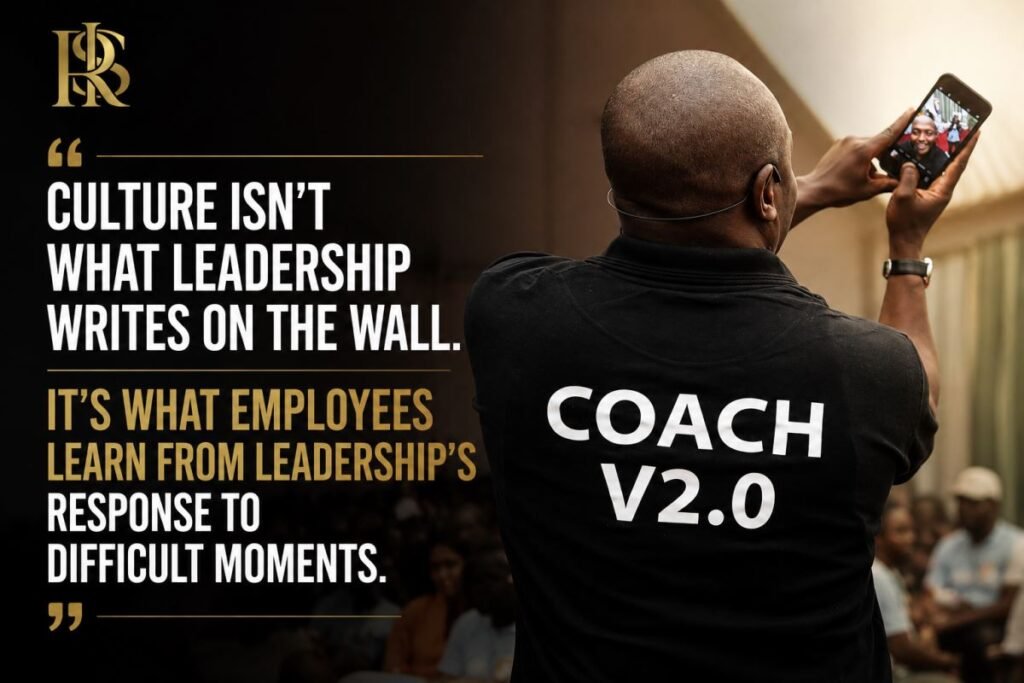
Culture Lives in Leadership Behavior - Not Company Values
Many organizations proudly display values such as:
- Integrity
- Transparency
- Accountability
- Innovation
But employees don’t learn culture from posters.
They learn it from repeated leadership behavior.
Every interaction teaches people:
- Which conversations are safe.
- Which mistakes are punished.
- Which information should be hidden.
- Which truths are welcome.
Over time these signals become the organization’s actual culture.
“AI should amplify leadership, not add another layer of complexity.”
Middle Management Is the Organization's Transmission System
Middle managers occupy one of the most important positions inside any company.
They translate:
Leadership’s strategy → Frontline execution
and
Frontline reality → Executive decision-making
When this layer functions well:
- Problems surface early.
- Information moves quickly.
- Decisions improve.
- Accountability increases.
- Trust grows.
When this layer becomes unhealthy, something much more dangerous happens.
The Silent Filter That Slows Organizations
Imagine a manager preparing a report.
Instead of asking:
"Is this accurate?"
They’re asking:
How do I present this without upsetting leadership?
Information begins to be:
- Filtered
- Softened
- Sanitized
- Politically adjusted
- Repackaged for comfort
Eventually executives stop receiving reality.
They receive a version of reality that has already passed through multiple layers of emotional filtering.
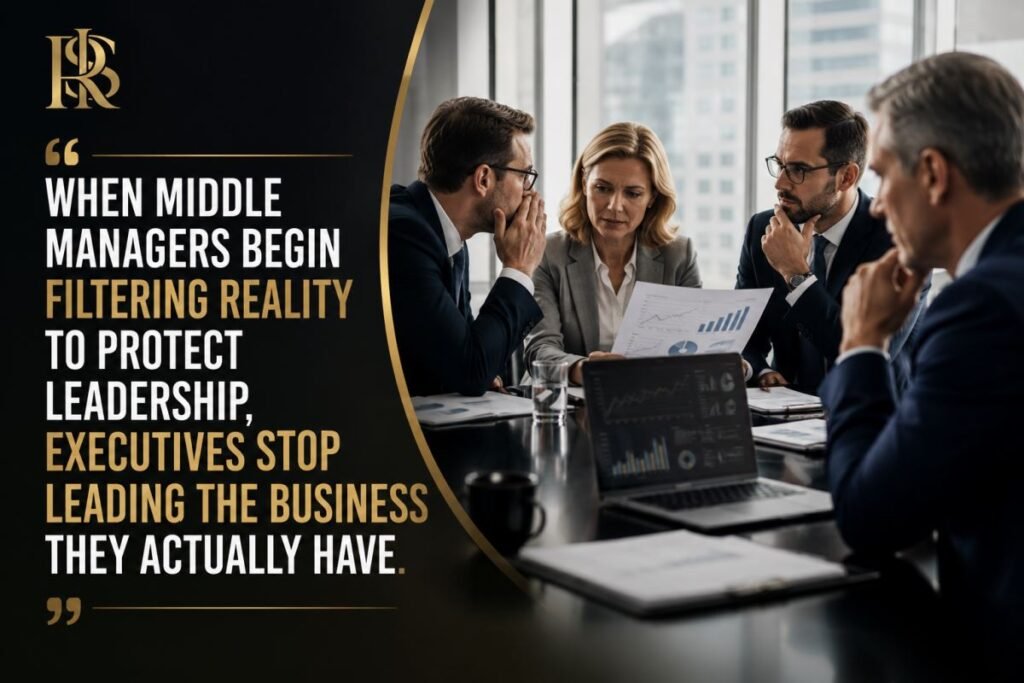
CEOs Begin Leading a Filtered Organization
When middle managers believe honesty carries personal risk, they naturally adapt.
Not because they’re dishonest.
Because they’re rational.
They’ve learned what is and isn’t safe to communicate.
As a result:
- Risks appear later.
- Customer issues remain hidden longer.
- Operational problems grow unnoticed.
- Innovation slows.
- Accountability weakens.
- Decision quality declines.
Executives unknowingly begin making strategic decisions using incomplete information.
That isn’t simply a communication issue.
It’s a leadership systems issue.
Why Middle Managers Filter Information
Very few organizations intentionally create this behavior.
Instead, it develops through thousands of leadership moments.
Middle managers learn by observing questions like:
- Is the CEO approachable today?
- Is now the wrong time?
- Will I be blamed?
- Will bringing this up damage my reputation?
- Will leadership shoot the messenger?
Each experience teaches employees whether truth is rewarded or punished.
Eventually filtering becomes organizational habit.
The Real Culture Problem Starts at the Top
When leaders protect egos more than truth, middle management adapts accordingly.
This creates a culture where:
- Problems arrive late.
- Reports become politically edited.
- Employees manage perceptions instead of performance.
- Leaders lose visibility into operational reality.
Ironically, executives often blame culture, when the behaviors creating that culture originated with leadership itself.
Psychological Safety Is a Leadership Discipline
Healthy organizations aren’t defined by the absence of bad news.
They’re defined by how quickly bad news reaches decision-makers.
Great leaders understand that early problems are cheaper to solve.
They intentionally create environments where employees can communicate:
- Mistakes
- Risks
- Customer feedback
- Operational failures
- Difficult conversations
without fear of embarrassment or punishment.
Truth travels faster in organizations where psychological safety exists.
Culture Is Built Through Repeated Leadership Choices
Culture is not an aspirational statement.
It is the accumulated result of thousands of leadership interactions.
Employees remember:
- How leaders respond under pressure.
- Whether difficult conversations are welcomed.
- Whether honesty creates opportunity or consequences.
Over time, those experiences become the organization’s operating system.
Three Leadership Questions Every CEO Should Ask
Instead of asking
"How do we improve culture?"
Ask:
- What behaviors are we consistently rewarding?
- How safe is it for middle managers to tell us uncomfortable truths?
- Are we making decisions based on reality—or filtered information?
The answers may reveal that your greatest competitive advantage isn’t another strategy.
It’s creating a leadership environment where truth moves freely.
Key Executive Takeaways
- Organizational culture is shaped by leadership behavior, not written values.
- Middle managers determine how accurately information flows throughout the company.
- Psychological safety directly affects executive decision quality.
- Sanitized reporting creates slower execution and poorer strategic decisions.
- Great leaders encourage bad news early because early problems are easier to solve.
Final Thought
If problems consistently reach executive leadership too late, the issue may not be employee engagement or organizational culture.
The real question is whether leadership has built an environment where truth can travel without being filtered.
The strongest organizations are not those with perfect cultures.
They are the ones where reality reaches decision-makers quickly enough to act.
Ready to Discover What's Really Slowing Your Organization?
If you’re a CEO, founder, or executive team committed to improving leadership effectiveness, decision quality, and organizational execution, get the leadership friction autopsy tool today: