
Your Culture Change Program Was Dead Before Launch: Why CEOs Must Fix the Operating System First
You spent millions on consultants. You held the executive retreat. You flew your leadership team to a luxury resort. You hired facilitators, redesigned your company values, launched a new culture campaign and maybe even gave everyone a branded coffee mug.
Eighteen months later, almost nothing has changed.
If that sounds familiar, the problem may not be your employees.
It may not even be your culture.
Your culture transformation may have failed before implementation ever began.
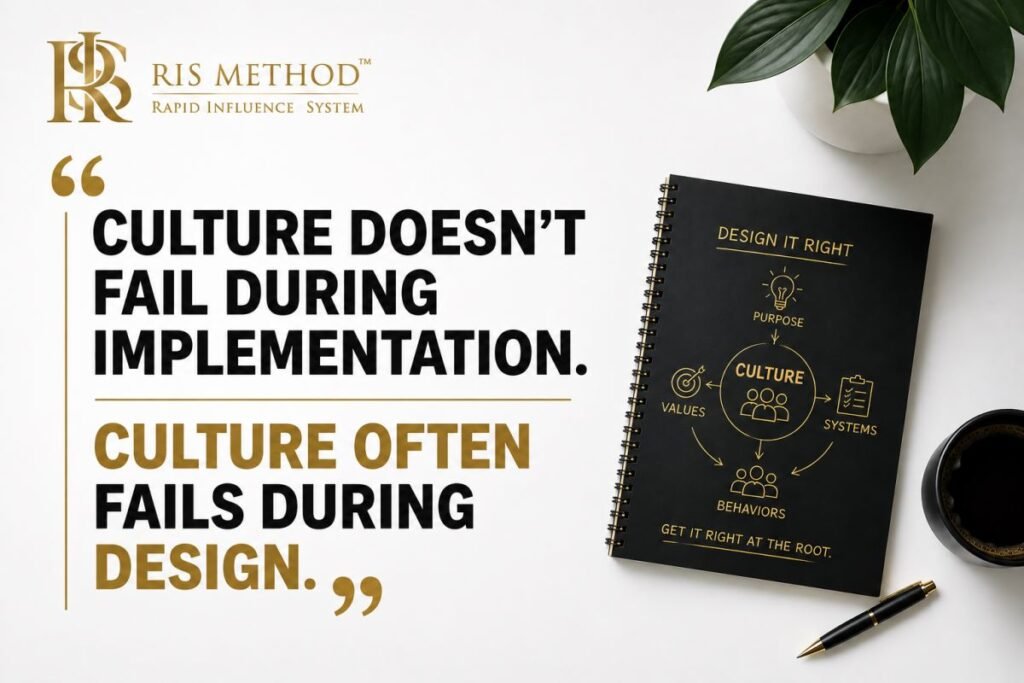
The reason is simple: culture doesn’t fail during implementation. Culture often fails during design.
For CEOs and senior leaders, this distinction is critical.
Because if the systems governing promotions, bonuses, performance reviews, hiring, accountability and executive behavior remain unchanged, no amount of posters, workshops or value statements will create a fundamentally different culture.
Culture Isn't What Employees Believe. It's What the Organization Reinforces.
One of the most persistent assumptions in corporate culture work is that culture is primarily about what employees believe.
It isn’t.
Culture is revealed by what people repeatedly experience.
Employees watch what leaders reward. They observe who gets promoted. They notice what behavior gets tolerated. They learn which executives receive praise, which behaviors get ignored and which political games produce results.
Eventually, employees answer one unconscious question:
“What actually gets rewarded around here?”
That answer becomes culture.
Not the values printed on the wall.
Not the employee handbook.
Not the speech delivered during the annual retreat.
The operating system tells people what the organization truly values.
“Most CEOs don’t have an AI problem. They have an operational clarity problem.”
The Culture Program That Changed Nothing
Consider a CEO who proudly announces a brand-new culture program.
The company has redesigned its values and launched the initiative.
But then ask a few simple questions:
- What changed in the bonus structure?
- What changed in promotion criteria?
- What changed in performance reviews?
- What changed in executive scorecards?
- What changed in hiring?
- What changed in who gets held accountable or fired?
If the answer to all of those questions is “nothing,” then what actually changed?
The language changed.
The presentation changed.
The posters changed.
But the organizational operating system remained exactly the same.
And organizations don’t execute language.
Organizations execute incentives, consequences and systems.
That is why a culture transformation can look impressive on launch day and be functionally dead eighteen months later.
People Don't Necessarily Resist Change. They Resist Uncertainty.
Another leadership myth is that employees naturally resist change.
But people change constantly.
They learn new software. They develop new skills. They adapt to market conditions. They change responsibilities and routines.
What people often resist is uncertainty, unfairness and perceived loss.
Employees become concerned when they believe a change could cost them:
- Status
- Certainty
- Rewards
- Influence
- Identity
- Career progression
This is why culture transformation must address the economics and systems surrounding behavior not simply ask people to “believe” in a new set of values.
“AI should amplify leadership, not add another layer of complexity.”
Behavior often comes before belief.
Consider military training.
People don’t begin by spending months philosophically believing themselves into becoming soldiers.
They first behave according to new standards.
Then routines change.
Then accountability changes.
Then standards become normalized.
Eventually, identity changes.
Organizations can work the same way.
Change the behavior and the system that reinforces it, and beliefs can begin to follow.
“The future belongs to CEOs who can turn operational noise into strategic intelligence.”
The Paycheck Must Agree With the Poster
Imagine two employees.
One consistently lives the company’s stated values.
The other routinely ignores them.
Both receive exactly the same bonus.
What did the organization just teach everyone?
The lesson is obvious:
The values are optional.
Now consider two leaders.
Leader A collaborates across departments, develops talent, shares information and delivers results.
Leader B hits the numbers but destroys trust, hoards information and undermines colleagues.
If Leader B gets promoted because they delivered short-term numbers, the organization has made its real culture perfectly clear.
The wall may say “collaboration.”
The incentive system says “individual performance matters more.”
Employees will believe the incentive system.
And they should.
Culture Is Built Through Consequences
Behavioral science has consistently demonstrated a simple principle:
Behaviors that are reinforced are more likely to be repeated.
That principle has enormous implications for executive leadership.
Employees pay attention to:
- What leaders celebrate
- What leaders reward
- What leaders tolerate
- What leaders ignore
- Who gets promoted
- Who gets protected
- Who gets held accountable
A company can have “integrity” written across every wall in the building.
But if employees know that political behavior produces promotions, then politics becomes part of the real culture.
The wall isn’t necessarily lying.
The incentive system is telling a different story.
Two Companies. Two Completely Different Cultures.
Imagine two manufacturing companies trying to improve collaboration.
Company A: The Culture Campaign
Company A launches a major culture initiative.
They create:
- A new mission statement
- Executive retreats
- Culture workshops
- Internal videos
- Branded notebooks
- New posters
- T-shirts
- Leadership presentations
Everyone is excited.
Eighteen months later, collaboration has barely improved.
Company B: The Operating-System Approach
Company B takes a different approach.
First, executive bonuses include measurable cross-functional collaboration.
Second, promotion decisions require evidence that leaders have developed other leaders.
Third, performance reviews measure knowledge sharing.
Fourth, recognition programs reward enterprise-level thinking rather than departmental victories.
The result?
Meetings begin to change.
Decision-making changes.
Leaders begin sharing information differently.
Teams become more collaborative.
Why?
Not because employees suddenly became better people.
The system changed.
And the culture followed.
Stop Starting With Values. Start With Friction.
This is where a different approach to culture transformation becomes necessary.
Instead of beginning with:
What values should our company have?
Start with:
“Where is the organization experiencing friction?”
Because culture problems frequently reveal themselves as operational friction:
- Decision friction
- Leadership friction
- Communication friction
- Execution friction
- Trust friction
- Accountability friction
If you don’t identify and address those structural barriers, adding another value statement can actually create more frustration.
Employees hear one thing.
They experience another.
Leadership says collaboration.
The bonus rewards individual performance.
Leadership says transparency.
Information hoarding gets rewarded.
Leadership says accountability.
High performers are allowed to violate standards.
Leadership says innovation.
People who make mistakes are punished.
The result is cynicism.
Not culture.
The Five Questions Every CEO Should Ask
If you are serious about changing your organization’s culture, start by examining what the organization actually reinforces.
Ask your executive team these five questions:
1. Who gets promoted?
Look beyond stated criteria.
Who actually advances?
What behaviors do those people consistently demonstrate?
2. Who gets rewarded?
Examine bonuses, recognition, compensation and access to opportunities.
What behaviors generate tangible rewards?
3. What gets tolerated?
Every organization has behaviors leadership says are unacceptable but quietly allows when the person involved is commercially valuable.
Those exceptions become cultural signals.
4. What behavior gets celebrated?
Listen carefully during executive meetings.
What behaviors receive recognition?
Who gets praised?
What accomplishments are repeatedly highlighted?
5. What behavior gets quietly ignored?
This may be the most revealing question of all.
Culture isn’t only created by what leaders reward.
It is also created by what they repeatedly choose not to confront.
Could a New Employee Diagnose Your Culture Without Reading Your Values?
Here’s a powerful test for any CEO.
Imagine removing every value statement from your company tomorrow.
Take down the posters.
Delete the slogans.
Remove the employee handbook.
Then bring in a new employee.
Could that person determine what kind of organization they had joined simply by observing:
- Who gets promoted?
- How decisions are made?
- How meetings operate?
- Who gets heard?
- Who gets ignored?
- What behavior receives recognition?
- What behavior has consequences?
- How leaders treat bad news?
If the answer is yes, your culture is embedded in your operating system.
If the answer is no, you may have a marketing campaign rather than a functioning culture.
Culture Is Not an Initiative. It Is an Outcome.
This is the fundamental shift CEOs need to make.
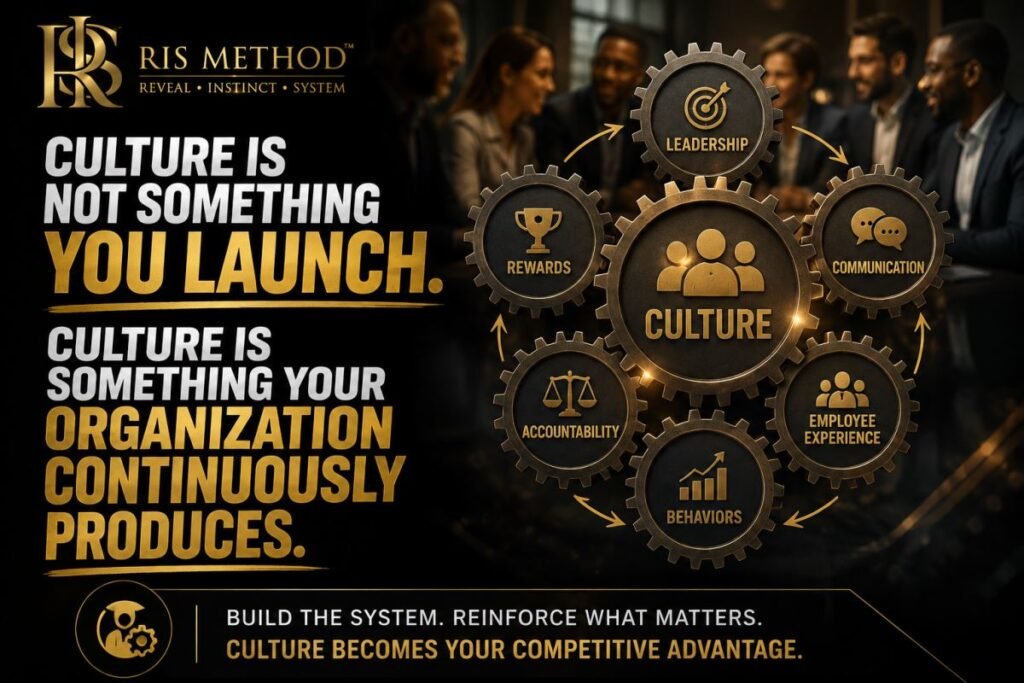
Culture is not something you launch.
Culture is something your organization continuously produces.
Every promotion produces a cultural signal.
Every bonus produces a cultural signal.
Every firing produces a cultural signal.
Every tolerated behavior produces a cultural signal.
Every executive meeting produces a cultural signal.
Every response to bad news produces a cultural signal.
Your employees are constantly interpreting those signals.
And eventually they determine:
“This is how things work here.”
That is culture.
Fix the Operating System and Culture Becomes Visible
The leadership mistake is trying to change culture directly while leaving the system that creates behavior untouched.
You cannot sustainably change culture by changing language alone.
You have to examine the mechanisms producing the behavior.
That means diagnosing the friction inside the organization first.
Where are decisions getting stuck?
Where is accountability breaking down?
Where are leaders sending contradictory signals?
Where does communication fail?
Where does trust deteriorate?
Where do incentives conflict with stated values?
Where does execution slow down?
These questions take you beneath the surface.
And that is where meaningful transformation begins.
Diagnose Before You Redesign
Before investing another million dollars in consultants, workshops, retreats and culture campaigns, take a hard look at your organization’s operating system.
Ask yourself:
- What is our organization currently rewarding?
- What are we currently tolerating?
- What behaviors are we unintentionally reinforcing?
- Where is leadership friction slowing execution?
- Where does the system contradict what leadership says it wants?
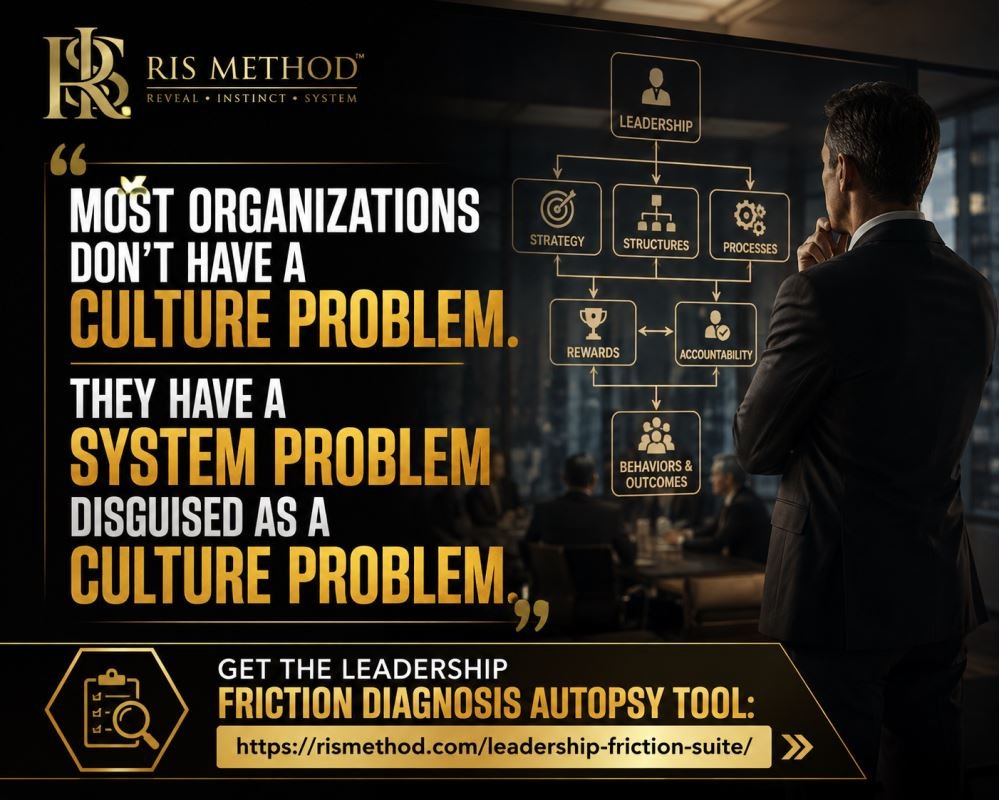
The answers may reveal that your organization doesn’t have a culture problem at all.
It has a system problem disguised as a culture problem.
Find the Friction Before You Try to Fix the Culture
The Leadership Friction Diagnosis Autopsy Tool is designed to help leaders identify the sources of friction or lag within their corporate culture and leadership systems.
The self-help AI tool analyzes your results and provides real-time suggestions for potential remedies based on what you uncover.
Instead of guessing where the problem is, start by diagnosing the friction.
Get access to the Leadership Friction Diagnosis Autopsy Tool here:
https://rismethod.com/leadership-friction-suite/
Because culture doesn’t begin with values.
It begins with the operating system that determines how people think, decide and perform.
Fix the system.
Change the behavior.
And the culture becomes visible.